







If you’re searching for evil Japanese names, you’re in the right place. Dark names can add mystery, danger, and power to any character. They work well for anime, manga, fantasy stories, games, and horror tales. The best evil Japanese names often have meanings linked to darkness, death, revenge, or fear.
Some names sound dark even before you know their meaning. Others become more interesting when you explore their history. This list includes dark Japanese names, Japanese names meaning dark, and Japanese dark names for different character types. You’ll also find names with unusual and powerful meanings.
Whether you need a villain, demon, rival, or mysterious hero, these evil Japanese names can spark ideas. You’ll discover Japanese names that mean death and Japanese names meaning death alongside names linked to darkness and danger. Each choice can give your character a stronger identity.
Evil Japanese Names With Dark and Sinister Meanings
If you’re looking for evil Japanese names, a dark meaning can give a character extra depth. These names can fit villains, demons, cursed figures, and mysterious characters. Some connect with darkness, death, shadows, revenge, or fear. Others simply create a sinister mood.
- Yami — Darkness
- Kuro — Black
- Yoru — Night
- Kage — Shadow
- Shi — Death
- Chi — Blood
- Aku — Evil
- Oni — Demon or ogre
- Ma — Demon or evil influence
- Jigoku — Hell
- Noroi — Curse
- Kurayami — Deep darkness
- Ankoku — Darkness
- Zetsubō — Despair
- Fukushū — Revenge
- Nikushimi — Hatred
- Konran — Chaos or confusion
- Metsubō — Destruction
- Hametsu — Ruin or destruction
- Kyōfu — Fear
- Kuroyuki — Black snow
- Kurotsuki — Black moon
- Yamikage — Dark shadow
- Yamiyo — Dark night
- Kurobara — Black rose
- Kurohana — Black flower
- Kurokage — Black shadow
- Yorukage — Night shadow
- Yoruhana — Night flower
- Kageyami — Shadow darkness
- Tsukikage — Moon shadow
- Shinigami — Death god
- Akumu — Nightmare
- Makai — Demon world
- Meikai — Underworld
- Mugen — Endless or infinite
- Kyōki — Madness
- Kyouaku — Wicked or heinous
- Zankoku — Cruelty
- Guren — Crimson or blazing lotus
- Homura — Flame
- Enma — Judge of the dead
- Kurohime — Black princess
- Yamihime — Dark princess
- Kurotsubaki — Black camellia
- Kurokumo — Black cloud
- Kuroyama — Black mountain
- Kuroishi — Black stone
- Kurobane — Black feather
- Yamitsuki — Dark moon-inspired name
These dark Japanese names can create different moods. Yami and Kage feel mysterious. Shinigami and Jigoku sound more supernatural. Fukushū and Nikushimi suit characters driven by revenge or hatred.
Best Evil Japanese Names for Dark Characters
The right name can make a fictional character instantly memorable. These evil Japanese names work well for villains, antiheroes, demons, rivals, and supernatural characters. They can also inspire names for anime, manga, games, novels, and dark fantasy stories.
- Akuma — Demon
- Yami — Darkness
- Kage — Shadow
- Kuro — Black
- Yoru — Night
- Shinigami — Death god
- Oni — Demon or ogre
- Noroi — Curse
- Akumu — Nightmare
- Jigoku — Hell
- Makai — Demon world
- Meikai — Underworld
- Zetsubō — Despair
- Fukushū — Revenge
- Nikushimi — Hatred
- Metsubō — Destruction
- Hametsu — Ruin
- Kyōfu — Fear
- Kyōki — Madness
- Zankoku — Cruelty
- Ankoku — Darkness
- Kurayami — Deep darkness
- Yamiyo — Dark night
- Yamikage — Dark shadow
- Kurotsuki — Black moon
- Kurobara — Black rose
- Kuroyuki — Black snow
- Kurokumo — Black cloud
- Kurobane — Black feather
- Kuroishi — Black stone
- Kuroyama — Black mountain
- Kurohana — Black flower
- Kageyama — Shadow mountain
- Kagehana — Shadow flower
- Kagebara — Shadow rose
- Tsukikage — Moon shadow
- Yorukage — Night shadow
- Yoruhana — Night flower
- Kuroneko — Black cat
- Kurohime — Black princess
- Yamihime — Dark princess
- Yamihiko — Dark-inspired male character name
- Yoruhiko — Night-inspired male name
- Kuroto — Black-inspired character name
- Kuroya — Black-night-inspired name
- Guren — Crimson or blazing lotus
- Homura — Flame
- Enma — Judge of the dead
- Kurotsubaki — Black camellia
- Yamitsuki — Dark moon-inspired name
These names can suit many types of evil characters. A shadow-based name works for a silent assassin. A death-related name fits a supernatural villain. Meanwhile, a name linked with revenge can suit a character who has fallen into darkness.
Evil Japanese Names Inspired by Japanese Folklore
Japanese folklore is filled with spirits, monsters, and mysterious beings. These stories offer plenty of inspiration for evil Japanese names. Many come from yokai, legendary creatures, haunted places, and supernatural figures. They can work especially well for dark fantasy, horror, anime, and manga characters.
- Kuchisake-onna — Slit-mouthed woman
- Aka Manto — Red cloak spirit
- Hanako-san — Famous bathroom ghost
- Teke Teke — Vengeful urban spirit
- Hachishakusama — Eight-foot-tall spirit
- Hone Onna — Skeleton woman
- Ubume — Ghost of a woman who died in childbirth
- Futakuchi-onna — Two-mouthed woman
- Rokurokubi — Long-necked supernatural woman
- Nukekubi — Floating head spirit
- Yuki-onna — Snow woman
- Jorōgumo — Spider woman
- Kijo — Demon woman
- Hannya — Jealous female demon
- Onryō — Vengeful spirit
- Goryō — Angry or vengeful ghost
- Yūrei — Japanese ghost
- Bakemono — Supernatural creature
- Obake — Shape-shifting spirit
- Tsuchinoko — Mysterious snake-like creature
- Nue — Chimera-like yokai
- Bakeneko — Supernatural cat
- Nekomata — Fork-tailed cat spirit
- Kasha — Cat-like demon associated with the dead
- Inugami — Dog spirit
- Kudan — Human-faced prophetic creature
- Kappa — Water-dwelling yokai
- Tengu — Mountain supernatural being
- Karasu Tengu — Crow-like tengu
- Daitengu — Powerful tengu
- Yamabiko — Mountain echo spirit
- Kodama — Tree spirit
- Mokumokuren — Spirit of countless eyes
- Nurarihyon — Mysterious yokai with a bald head
- Noppera-bō — Faceless ghost
- Amefuri Kozō — Rain-associated spirit
- Kasabake — Living umbrella spirit
- Karakasa-obake — One-legged umbrella yokai
- Chōchin-obake — Haunted paper lantern
- Bakekujira — Ghostly whale
- Umibōzu — Sea spirit
- Funayūrei — Ghosts of drowned sailors
- Isogashi — Restless supernatural creature
- Amabie — Legendary prophetic sea creature
- Jikininki — Corpse-eating spirit
- Gashadokuro — Giant skeleton spirit
- Shōjō — Red-haired mythical creature
- Satori — Mind-reading mountain creature
- Akaname — Filth-licking yokai
- Kameosa — Strange turtle-like yokai
These Japanese folklore names have very different personalities. Kuchisake-onna feels frightening and mysterious, while Jikininki creates a darker horror mood. Names such as Gashadokuro, Umibōzu, and Jorōgumo can give a character an instantly supernatural identity.
Evil Japanese Names for Villains and Antagonists
A memorable villain needs more than a threatening personality. A strong name can hint at the character’s past, powers, or intentions. These evil Japanese names suit villains, antagonists, dark rivals, assassins, and supernatural enemies. They can fit stories ranging from realistic crime dramas to dark fantasy adventures.
- Ryūjin — Dragon deity of the sea
- Susanoo — Storm deity from Japanese mythology
- Kagutsuchi — Deity associated with fire
- Izanami — Goddess connected with death and the underworld
- Izanagi — Mythological creator deity
- Amaterasu — Sun goddess
- Tsukuyomi — Moon deity
- Hachiman — Deity associated with war
- Bishamonten — Deity associated with warriors
- Fudō Myōō — Fierce Buddhist guardian
- Aizen Myōō — Wisdom king associated with desire
- Kongōrikishi — Powerful guardian figure
- Raijin — Thunder deity
- Fūjin — Wind deity
- Tenjin — Deified historical scholar
- Ōkuninushi — Important figure in Japanese mythology
- Sarutahiko — Powerful kami associated with guidance
- Takemikazuchi — Martial deity
- Hōmusubi — Fire deity
- Owatatsumi — Sea deity
- Yamata-no-Orochi — Eight-headed serpent
- Shuten-dōji — Legendary oni leader
- Ibaraki-dōji — Famous oni
- Kintarō — Legendary strongman
- Momotarō — Peach Boy
- Urashima Tarō — Legendary fisherman
- Issun-bōshi — One-inch warrior
- Benkei — Legendary warrior monk
- Minamoto no Raikō — Legendary warrior
- Watanabe no Tsuna — Famous warrior from legend
- Kiyohime — Woman transformed by jealousy
- Tamamo-no-Mae — Legendary fox spirit
- Kuzunoha — Legendary fox woman
- Hōrai — Mythical land associated with immortality
- Yomotsu Hirasaka — Entrance to the land of the dead
- Yomi — Underworld in Japanese mythology
- Amanojaku — Mischievous and wicked supernatural being
- Jakuren — Dark-inspired fictional character name
- Kurozane — Black-metal-inspired fictional name
- Akagane — Copper or red-metal-inspired name
- Kurogane — Black iron
- Ginrei — Silver spirit-inspired name
- Kurohane — Black feather-inspired name
- Shiranui — Mysterious ghostly fire
- Kagaribi — Watch fire or beacon flame
- Kuroshio — Black current
- Arashi — Storm
- Raimei — Thunderclap
- Kaminari — Thunder
- Shinku — Deep crimson
These Japanese villain names can suit different kinds of antagonists. A character inspired by Yamata-no-Orochi could have multiple forms or overwhelming power. Someone inspired by Tamamo-no-Mae might rely on deception and supernatural charm. Meanwhile, a warrior villain could draw inspiration from Shuten-dōji or Fudō Myōō.
Evil Japanese Names With Powerful Meanings
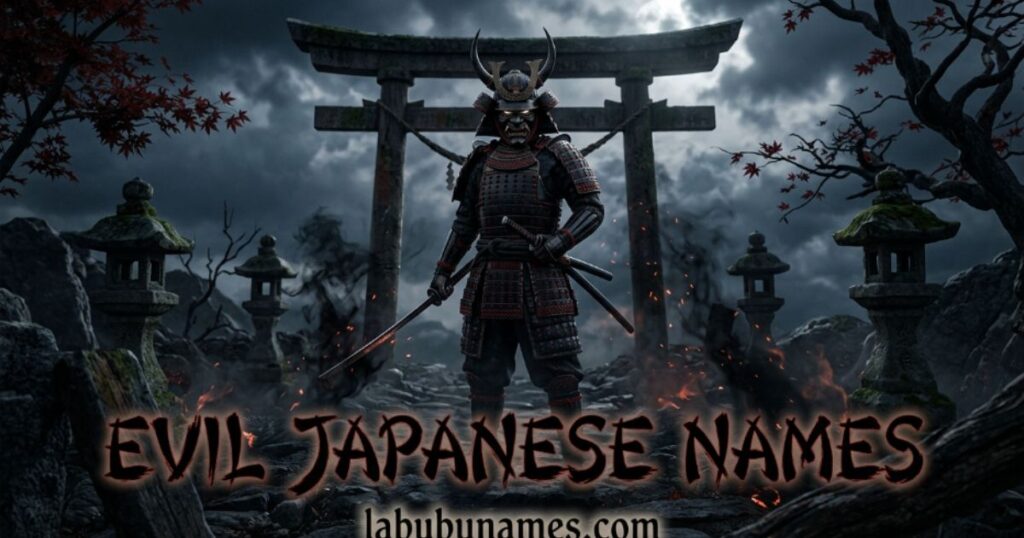
A powerful name can instantly make a character feel stronger. For evil Japanese names, the meaning can add even more depth. Names linked with storms, fire, warriors, darkness, fate, and destruction can suit characters who command fear. They also work well in anime, manga, games, and dark fantasy stories.
- Kenshin — Humble truth
- Kenshiro — Strong and determined man
- Takeshi — Warrior or strong
- Takeo — Warrior man
- Isamu — Courage
- Masaru — Victory
- Katsuo — Victorious man
- Katsuro — Victorious son
- Ryu — Dragon
- Ryūji — Dragon ruler
- Ryūnosuke — Dragon helper
- Tatsuya — Accomplished dragon
- Tatsuo — Dragon man
- Raiden — Thunder and lightning
- Raimei — Thunderclap
- Arashi — Storm
- Kaminari — Thunder
- Homura — Flame
- Enjin — Flame or fire-inspired name
- Kazan — Volcano
- Kōga — Hard fang
- Gai — Strength or victory
- Gaku — Mountain or learning
- Issei — First-born
- Jin — Benevolence
- Jō — Strong or pure
- Kōji — Strong second son
- Makoto — Sincerity or truth
- Mamoru — Protector
- Naoki — Honest tree
- Osamu — Discipline or governance
- Reiji — Respectful second son
- Ren — Lotus
- Riku — Land
- Rikuo — Land king
- Shin — True or genuine
- Shinji — True second son
- Shiro — White
- Shō — Soar or fly
- Takumi — Artisan or skilled craftsman
- Tōma — Winter-inspired name
- Yasuo — Peaceful man
- Yūji — Brave second son
- Yūto — Gentle or courageous person
- Zen — Meditation or calm
- Akihiro — Bright and prosperous
- Hideaki — Excellent and bright
- Noboru — Rise or ascend
- Masahiro — Broad justice
- Tadashi — Correct or righteous
These names don’t all mean evil literally. Instead, they carry powerful ideas that can shape a dark character. For example, Ryu suggests a dragon-like presence, while Arashi evokes the force of a storm. Homura brings the image of fierce flames.
Evil Japanese Names for Male Characters
Finding evil Japanese names for a male character can be tricky when the name needs to sound natural yet memorable. A villain might be cold and calculating, fiercely loyal, or completely unpredictable. These names offer different styles for male characters in anime, manga, novels, games, and fantasy stories.
- Daichi — Great land
- Daigo — Great enlightenment
- Daisuke — Great helper
- Eiji — Prosperous second son
- Genji — Source or origin
- Goro — Fifth son
- Hajime — Beginning
- Hayato — Falcon person
- Hideo — Excellent man
- Hiroshi — Generous or broad-minded
- Ichiro — First son
- Jiro — Second son
- Kaito — Ocean or soaring
- Kaname — Vital point
- Keiji — Respectful second son
- Keisuke — Respectful helper
- Kenta — Healthy and strong
- Kiyoshi — Pure or clean
- Kojiro — Little second son
- Kōta — Great peace
- Manabu — Learning
- Minato — Harbor
- Naoto — Honest person
- Norio — Lawful man
- Renji — Lotus second son
- Ryo — Refreshing or excellent
- Ryōhei — Peaceful and prosperous
- Ryōma — Dragon and horse
- Saburo — Third son
- Satoru — Enlightenment or understanding
- Seiji — Correct government
- Shigeru — Luxuriant or flourishing
- Shinobu — Endurance
- Shōgo — Soaring enlightenment
- Shun — Talented or fast
- Sōma — Horse or truth-inspired name
- Taichi — Great first son
- Taiga — Big river
- Taiki — Great radiance
- Takashi — Noble or prosperous
- Takeru — Warrior or brave
- Takuya — Expanding or pioneering
- Tomoya — Wise friend
- Toru — To pass through
- Yasushi — Peaceful
- Yoshiro — Good or righteous son
- Yukio — Courageous man
- Yusaku — Brave or useful
- Yuichi — Brave first son
- Yujiro — Brave second son
These dark Japanese male names can fit many character types. Takeru or Takeshi can suit a hardened warrior. Satoru works well for a clever mastermind. Meanwhile, names such as Ryōma, Hayato, and Taiga can give a powerful antagonist a bold identity.
Evil Japanese Names for Female Characters
A female villain can be elegant, clever, ruthless, or completely unpredictable. The right name helps bring that personality to life. These evil Japanese names work well for female villains, witches, demons, assassins, rivals, and dark fantasy characters.
- Aiko — Beloved child
- Akane — Deep red
- Aki — Autumn
- Amaya — Night rain
- Ayame — Iris flower
- Chiyo — Thousand generations
- Eiko — Prosperous child
- Emi — Beautiful blessing
- Fumiko — Child of treasured beauty
- Hana — Flower
- Haruka — Distant or far away
- Hikari — Light
- Himari — Sun or light-inspired name
- Hitomi — Eye or pupil
- Hotaru — Firefly
- Izumi — Spring or fountain
- Kaede — Maple
- Kaho — Summer sail
- Kana — Powerful or beautiful
- Kanna — Divine or supernatural-inspired name
- Kaori — Fragrance
- Kasumi — Mist
- Kikyo — Bellflower
- Kira — Glitter or sparkle
- Kiyomi — Pure beauty
- Koharu — Little spring
- Kokoro — Heart
- Kotone — Sound of koto
- Kumiko — Longtime beautiful child
- Mai — Dance
- Maiko — Dancing child
- Maki — True hope
- Mana — Love or affection
- Mariko — True child
- Mayu — True gentleness
- Megumi — Blessing
- Mei — Brightness
- Michiko — Beautiful wise child
- Misaki — Beautiful blossom
- Miyako — Beautiful child
- Mizuki — Beautiful moon
- Nana — Seven
- Natsuki — Summer hope
- Nozomi — Hope
- Reika — Beautiful flower
- Rin — Dignified or cold
- Sakura — Cherry blossom
- Shiori — Bookmark or guide
- Tomoko — Wise child
- Yukari — Connection or relationship
These dark Japanese female names offer many different moods. Akane can evoke a deep crimson color, while Kasumi feels softer and more mysterious. Rin can suit a cold and calculating character. For a supernatural villain, names such as Kanna, Mizuki, or Hotaru can create an eerie atmosphere.
Evil Japanese Names for Anime and Manga Characters
Anime and manga often feature characters with dramatic personalities and unforgettable names. A good name should match the character without sounding forced. These evil Japanese names can suit villains, antiheroes, dark rivals, supernatural beings, and mysterious fighters.
- Akatsuki — Dawn
- Beniko — Crimson child
- Chikage — Blood shadow-inspired name
- Daiki — Great radiance
- Fumihiro — Abundant writing
- Genshin — Original or profound mind
- Hibiki — Echo
- Hikariya — Light-inspired character name
- Isana — Whale
- Jinrai — Thunderclap
- Kagehisa — Lasting shadow-inspired name
- Kairi — Ocean village or separation
- Kakashi — Scarecrow
- Katsumi — Victory and beauty
- Kazuki — Harmony or hope
- Kazuma — Harmony or true reality
- Keita — Blessed person
- Kensaku — Search or investigation
- Kōhei — Peace
- Kōsuke — Great helper
- Kurama — Mountain name associated with Japanese legend
- Kyōya — Powerful or respectful night-inspired name
- Mikado — Imperial ruler
- Mitsuo — Shining man
- Nagi — Calm
- Nobunaga — Faith or longevity
- Ranmaru — Orchid-inspired historical name
- Rei — Spirit or gratitude
- Reon — Lion-inspired modern name
- Rinzo — Dignified third son
- Ritsu — Law or order
- Rokuro — Six
- Ryūga — Dragon fang
- Ryūsei — Shooting star
- Sakon — Left-side guardian-inspired name
- Seiryu — Azure dragon
- Shiki — Four seasons or ceremonial period
- Shinra — Mythology-inspired name
- Shirogane — Silver
- Sōji — Historical samurai-inspired name
- Sōsuke — Assistant or helper
- Tatsuki — Dragon and hope
- Tōji — Winter or east governance
- Ugetsu — Rain moon
- Yashiro — Shrine or eight generations
- Yato — Night or myth-inspired name
- Yoruichi — Night-inspired character name
- Yūrei — Ghost
- Zan — Cutting or slashing-inspired name
- Zekū — Empty sky-inspired name
These dark anime names can fit characters with very different roles. Seiryu can suit a powerful dragon-themed fighter. Ugetsu has a mysterious and poetic feel. Meanwhile, names like Yato, Shiki, and Kurama can work well for characters surrounded by supernatural themes.
Evil Japanese Names Inspired by Demons and Spirits
Japanese mythology and folklore offer countless ideas for dark characters. Demons, ghosts, spirits, and supernatural creatures often have striking names. These evil Japanese names can inspire villains, cursed warriors, dark spirits, and supernatural enemies in fantasy stories.
- Amanozako — Fierce supernatural being
- Amanojaku — Wicked supernatural creature
- Ashura — Fierce warrior spirit
- Basan — Fire-breathing bird yokai
- Baku — Dream-eating creature
- Betobeto-san — Mysterious following spirit
- Datsueba — Old woman guarding the underworld
- Dorotabō — Mud-covered spirit
- Enenra — Smoke-like yokai
- Gagoze — Monstrous demon from legend
- Gaki — Hungry ghost
- Hakutaku — Mythical wise creature
- Hiderigami — Drought-causing spirit
- Hitodama — Floating human soul
- Hōkō — Supernatural fox-like creature
- Ippon-datara — One-legged mountain yokai
- Isonade — Shark-like sea monster
- Jubokko — Blood-drinking tree yokai
- Kameosa — Strange turtle-like yokai
- Kamaitachi — Weasel-like wind spirit
- Karakasa — Haunted umbrella spirit
- Kijimuna — Tree-dwelling spirit
- Kirin — Mythical sacred beast
- Kodan — Prophetic creature
- Konaki-jiji — Crying child-like yokai
- Kurozuka — Legendary demon woman
- Mikoshi-nyūdō — Tall supernatural apparition
- Mujina — Shapeshifting badger spirit
- Namahage — Fierce folklore being
- Nure-onna — Snake-like woman
- Ōmukade — Giant centipede monster
- Otoroshi — Hair-covered gate guardian
- Sazae-oni — Shell-like sea yokai
- Shikigami — Supernatural spirit servant
- Shiro-uneri — Animated kitchen object
- Sunekosuri — Small creature that brushes against legs
- Takaonna — Tall female yokai
- Tatarimokke — Bird-like vengeful spirit
- Tenjō-kudari — Ceiling-dwelling yokai
- Tsukumogami — Spirit inhabiting an old object
- Ushi-oni — Ox-headed monster
- Wanyūdō — Burning wheel spirit
- Yadokai — House-associated supernatural being
- Yamauba — Mountain witch
- Yamawaro — Mountain-dwelling creature
- Yasha — Fierce supernatural being
- Yatagarasu — Three-legged sacred crow
- Yomotsushikome — Female spirits of the underworld
- Zashiki-warashi — House spirit
- Zenko — Benevolent fox spirit
These Japanese names inspired by demons can create different moods. Ushi-oni feels monstrous and brutal, while Yamauba gives a character a witch-like personality. A name such as Shikigami works especially well for a supernatural servant controlled by a powerful villain.
Evil Japanese Names That Sound Mysterious and Dark
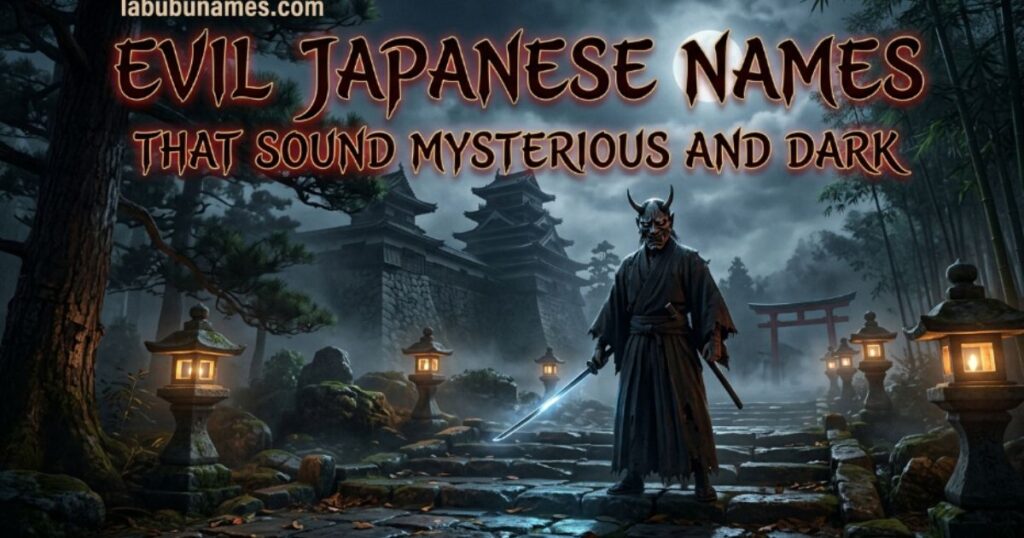
Sometimes a name doesn’t need an obviously evil meaning to feel sinister. Sound, imagery, and atmosphere can do the work. These evil Japanese names have a mysterious quality that can suit quiet villains, cursed characters, assassins, and supernatural figures.
- Akatsuki — Dawn
- Aoi — Blue or hollyhock
- Asahi — Morning sun
- Ayaka — Color or flower
- Chihaya — Thousand swift
- Ena — Blessing or favor
- Fuyuki — Winter tree
- Ginka — Silver flower
- Haku — White or pure
- Hibana — Spark or flame
- Hikage — Shade or shadow
- Hoshiko — Star child
- Itsuki — Tree
- Kagami — Mirror
- Kaguya — Shining night-inspired legendary name
- Kanon — Sound or flower-inspired name
- Kazane — Wind sound
- Kiri — Mist
- Kisara — Elegant or legendary-inspired name
- Kōri — Ice
- Kumo — Cloud
- Mikage — Sacred shadow or reflection
- Mio — Beautiful cherry blossom
- Mizore — Sleet
- Murasaki — Purple
- Nagisa — Shore
- Nagi — Calm
- Natsume — Jujube tree
- Oboro — Hazy or indistinct
- Reiha — Spirit and feather-inspired name
- Renge — Lotus
- Rikka — Winter flower
- Rinrei — Dignified spirit-inspired name
- Sae — Clear or vivid
- Sayo — Night generation
- Seika — Star or pure flower
- Shigure — Late autumn rain
- Shion — Aster flower
- Shizuku — Drop
- Sora — Sky
- Suiren — Water lily
- Suzune — Bell sound
- Tōka — Winter flower
- Tsukiko — Moon child
- Tsukishiro — Moon white
- Utsuro — Hollow or fleeting
- Yoruha — Night leaf-inspired name
- Yūgure — Twilight
- Yukishiro — Snow white
- Zanshin — Remaining awareness
These mysterious Japanese names are useful when a character’s identity should remain hidden. Oboro can suggest something hazy or difficult to understand. Shigure has a quiet, melancholic feel. Yūgure, meaning twilight, works nicely for a character who exists between light and darkness.
Evil Japanese Names Based on Death and Darkness
Death and darkness create a powerful atmosphere in fiction. These evil Japanese names draw inspiration from shadows, night, the underworld, silence, endings, and other dark imagery. They can suit villains, cursed warriors, spirits, assassins, and characters surrounded by mystery.
- Yamikiri — Dark cutter
- Kagekiri — Shadow cutter
- Kurokiri — Black cutter
- Yorukiri — Night cutter
- Shikage — Death shadow-inspired name
- Shiyami — Death darkness-inspired name
- Shikuro — Death and black-inspired name
- Shiyoru — Death and night-inspired name
- Meikage — Underworld shadow-inspired name
- Meiyami — Underworld darkness-inspired name
- Yomikage — Underworld shadow
- Yomiyami — Underworld darkness
- Yomikuro — Underworld black-inspired name
- Kurotsume — Black claw
- Yamitsume — Dark claw
- Kagetsume — Shadow claw
- Kurokiba — Black fang
- Yamikiba — Dark fang
- Kagekiba — Shadow fang
- Yorukiba — Night fang
- Kurohono — Black flame-inspired name
- Yamihono — Dark flame-inspired name
- Kagehono — Shadow flame-inspired name
- Kurohi — Black fire
- Yamibi — Dark fire-inspired name
- Kagebi — Shadow fire-inspired name
- Yorubi — Night fire-inspired name
- Kurokaze — Black wind
- Yamikaze — Dark wind
- Kagekaze — Shadow wind
- Yorukaze — Night wind
- Kuroame — Black rain
- Yamiame — Dark rain
- Kageame — Shadow rain
- Yoruame — Night rain
- Kurotsubasa — Black wing
- Yamitsubasa — Dark wing
- Kagetsubasa — Shadow wing
- Yorutsubasa — Night wing
- Kurobara — Black rose
- Yamibara — Dark rose
- Kagebara — Shadow rose
- Yorubara — Night rose
- Kurohoshi — Black star
- Yamihoshi — Dark star
- Kagehoshi — Shadow star
- Yoruhoshi — Night star
- Kurotsuki — Black moon
- Yamitsuki — Dark moon
These names focus on Japanese names meaning death and darkness-inspired imagery rather than claiming that every name literally means death. Words such as kuro, yami, kage, and you create strong visual themes involving blackness, darkness, shadows, and night.
Evil Japanese Names Inspired by Japanese Mythology
Japanese mythology offers a deep pool of gods, legendary warriors, supernatural creatures, and underworld stories. These evil Japanese names draw inspiration from that rich tradition. Some connect with powerful deities, legendary figures, sacred creatures, or places from ancient Japanese stories.
- Ame-no-Uzume — Goddess associated with dawn and dance
- Ame-no-Tajikarao — Deity of strength
- Ame-no-Koyane — Deity associated with ritual
- Ame-no-Minakanushi — Primordial deity
- Takami-Musubi — Creator deity
- Kami-Musubi — Creation deity
- Haya-Akitsu-hiko — Mythological deity
- Haya-Akitsu-hime — Mythological goddess
- Toyotama-hime — Sea goddess
- Tamayori-hime — Mythological princess
- Konohanasakuya-hime — Goddess associated with blossoms
- Iwanaga-hime — Goddess associated with enduring stone
- Wakahirume — Mythological female deity
- Toyouke — Deity associated with food and nourishment
- Ame-no-Hohi — Heavenly deity
- Ame-no-Wakahiko — Heavenly youth deity
- Ame-no-Tokotachi — Primordial deity
- Kuni-no-Tokotachi — Primordial earthly deity
- Uhijini — Primordial deity
- Suhijini — Primordial goddess
- Tsunoguhi — Primordial deity
- Ikuguhi — Primordial deity
- Ōtonoji — Primordial deity
- Ōtonobe — Primordial goddess
- Omodaru — Primordial deity
- Ayakashikone — Primordial goddess
- Izanagi-no-Mikoto — Creator deity
- Izanami-no-Mikoto — Creator goddess
- Susanoo-no-Mikoto — Storm deity
- Amaterasu-Ōmikami — Sun goddess
- Tsukuyomi-no-Mikoto — Moon deity
- Ōwatatsumi-no-Kami — Sea deity
- Kotoshironushi — Mythological deity
- Sukunabikona — Small but powerful deity
- Ōmononushi — Serpent-associated deity
- Takeminakata — Mythological warrior deity
- Futsunushi — Martial deity
- Ame-no-Futotama — Ritual deity
- Sarutahiko-Ōkami — Powerful guide deity
- Ukanomitama — Deity associated with food
- Inari-Ōkami — Deity associated with rice and prosperity
- Hachiman-Ōkami — Deity associated with warriors
- Konohanasakuya — Blossom goddess-inspired name
- Oyamatsumi — Mountain deity
- Kamimusubi — Divine creator
- Takamimusubi — High creator deity
- Ōkuninushi-no-Kami — Powerful earthly deity
- Yamato Takeru — Legendary warrior
- Prince Ōsu — Legendary prince
- Nomi no Sukune — Legendary sumo wrestler
- Jimmu Tennō — Legendary first emperor
These Japanese mythology names can give a fictional character a grand and ancient feel. A villain inspired by Susanoo might have storm-based abilities. Another character could draw from Izanami and develop a connection with death or the underworld.
Evil Japanese Names for Fantasy Stories and Games
Fantasy stories and games need names that feel memorable from the first encounter. These evil Japanese names can suit dark rulers, cursed warriors, assassins, monsters, and supernatural enemies. Some names suggest power, while others create an eerie or mysterious atmosphere.
- Kurojin — Black person or dark figure-inspired name
- Yamigami — Dark god-inspired name
- Kagegami — Shadow god-inspired name
- Yorugami — Night god-inspired name
- Kurohaku — Black and white-inspired name
- Yamihaku — Dark and pure-inspired name
- Kagehaku — Shadow and white-inspired name
- Kurotaka — Black hawk
- Yamitaka — Dark hawk-inspired name
- Kagetaka — Shadow hawk-inspired name
- Yorutaka — Night hawk-inspired name
- Kurokiba — Black fang
- Yamikiba — Dark fang
- Kagekiba — Shadow fang
- Yorukiba — Night fang
- Kurotsuru — Black crane
- Yamitsuru — Dark crane-inspired name
- Kagetsuru — Shadow crane-inspired name
- Yorutsuru — Night crane-inspired name
- Kurotora — Black tiger
- Yamitora — Dark tiger-inspired name
- Kagetora — Shadow tiger-inspired name
- Yorutora — Night tiger-inspired name
- Kurohebi — Black snake
- Yamihebi — Dark snake-inspired name
- Kagehebi — Shadow snake-inspired name
- Yoruhebi — Night snake-inspired name
- Kuroōkami — Black wolf
- Yamiōkami — Dark wolf-inspired name
- Kageōkami — Shadow wolf-inspired name
- Yoruōkami — Night wolf-inspired name
- Kuroryū — Black dragon
- Yamiryū — Dark dragon-inspired name
- Kageryū — Shadow dragon-inspired name
- Yoruryū — Night dragon-inspired name
- Kurotsubasa — Black wing
- Yamitsubasa — Dark wing-inspired name
- Kagetsubasa — Shadow wing-inspired name
- Yorutsubasa — Night wing-inspired name
- Kurokiba — Black fang-inspired name
- Yamikiba — Dark fang-inspired name
- Kagekiba — Shadow fang-inspired name
- Yorukiba — Night fang-inspired name
- Kurotsume — Black claw
- Yamitsume — Dark claw-inspired name
- Kagetsume — Shadow claw-inspired name
- Yorutsume — Night claw-inspired name
- Kurokami — Black hair or black deity-inspired name
- Yamikami — Dark deity-inspired name
These names can work especially well in games where characters need a strong visual identity. A black dragon, shadow assassin, or night-based warrior can easily inspire names built around words such as kuro, yami, kage, and yoru.
Evil Japanese Names With Sinister Symbolism
A name can suggest danger without directly meaning evil. Symbols such as blood, thorns, broken blades, ravens, storms, and dying flowers can create a sinister mood. These evil Japanese names draw on that kind of imagery and work well for villains, cursed characters, and dark fantasy figures.
- Kurenai — Crimson or deep red
- Shinku — Deep crimson
- Akabana — Red flower
- Akatsume — Red claw-inspired name
- Akakage — Red shadow-inspired name
- Akayami — Red darkness-inspired name
- Akaishi — Red stone
- Akatsubasa — Red wing-inspired name
- Akakiba — Red fang-inspired name
- Akatsuki — Dawn
- Kurobara — Black rose
- Kurokiku — Black chrysanthemum-inspired name
- Kurofuyu — Black winter-inspired name
- Kurotsuyu — Black dew-inspired name
- Kurohana — Black flower
- Kurokiri — Black mist-inspired name
- Kurokumo — Black cloud
- Kuroshio — Black current
- Kuroame — Black rain-inspired name
- Kurokaze — Black wind-inspired name
- Kurohi — Black fire-inspired name
- Yamitsuyu — Dark dew-inspired name
- Yamikiri — Dark mist-inspired name
- Yamikumo — Dark cloud-inspired name
- Yamikaze — Dark wind-inspired name
- Yamihi — Dark fire-inspired name
- Yamihana — Dark flower-inspired name
- Yamifuyu — Dark winter-inspired name
- Kagehana — Shadow flower
- Kagekiri — Shadow mist-inspired name
- Kagekumo — Shadow cloud-inspired name
- Kageame — Shadow rain-inspired name
- Kagekaze — Shadow wind-inspired name
- Kagehi — Shadow fire-inspired name
- Kagesora — Shadow sky-inspired name
- Kageishi — Shadow stone-inspired name
- Kagekusa — Shadow grass-inspired name
- Kagebara — Shadow rose
- Yorihana — Night flower-inspired name
- Yorukumo — Night cloud-inspired name
- Yoruame — Night rain-inspired name
- Yorukaze — Night wind-inspired name
- Yorukiri — Night mist-inspired name
- Yorushi — Night death-inspired name
- Yoruhoshi — Night star-inspired name
- Yorusora — Night sky-inspired name
- Yoruhana — Night flower-inspired name
- Yorutsuki — Night moon-inspired name
- Yorutori — Night bird-inspired name
These names use dark symbolism to create a particular mood. Crimson can suggest blood or revenge. Black flowers can represent mystery or grief. Shadows can hint at secrets, while storms and fire can suggest destruction.
Evil Japanese Names for Powerful Villain Characters
A powerful villain needs a name that feels commanding. These evil Japanese names can suit dark kings, ruthless warriors, masterminds, cursed rulers, and supernatural enemies. Each name is designed to create a strong impression without making every character sound exactly the same.
- Kurogane — Black iron
- Tetsuya — Iron-inspired name
- Tetsuo — Iron man
- Tetsushi — Iron warrior-inspired name
- Kōetsu — High joy or excellence
- Kōryū — Light dragon-inspired name
- Kōten — High heaven
- Kōmei — Bright wisdom
- Kōshin — Bright truth
- Kōga — Hard fang
- Gō — Strong or powerful
- Gōichi — Strong first son
- Gōtarō — Strong eldest son
- Gōji — Strong second son
- Tatsunori — Dragon law
- Tatsuhiko — Dragon prince
- Tatsumasa — Dragon justice
- Tatsuharu — Dragon spring
- Ryūichi — First dragon son
- Ryūjiro — Second dragon son
- Ryūken — Dragon sword
- Ryūjinmaru — Dragon-god-inspired name
- Kensaku — Sword seeker
- Kenjiro — Strong second son
- Kenzō — Strong third son
- Kenichi — Strong first son
- Kenji — Strong second son
- Kenma — Sword and demon-inspired name
- Toshirō — Talented son
- Toshiki — Wise and talented
- Toshio — Talented man
- Nobukage — Faithful shadow-inspired name
- Nobuyuki — Faith and happiness
- Nobumasa — Faith and justice
- Masakage — Justice and shadow-inspired name
- Masamune — Righteousness and truth
- Masayuki — Justice and happiness
- Masatsugu — Justice and succession
- Tadamasa — Loyal justice
- Tadakage — Loyal shadow-inspired name
- Tadayoshi — Loyal and righteous
- Yoshikage — Good shadow-inspired name
- Yoshitaka — Good and noble
- Yoshimasa — Good justice
- Yoshinori — Righteous law
- Kageakira — Shadow and brightness-inspired name
- Kagehiro — Broad shadow-inspired name
- Kagemasa — Shadow and justice-inspired name
- Kagetoshi — Shadow and wisdom-inspired name
- Kagenori — Shadow and law-inspired name
A villain’s name should match the kind of power they possess. Kurogane feels cold and unbreakable, making it suitable for a warrior who never retreats. Ryūken has a sharper fantasy feel and could suit a dragon-powered swordsman. Meanwhile, Masamune can work for a calculating ruler who believes his actions are justified.
Evil Japanese Names Inspired by Dark Legends
Dark legends often survive because they combine fear, mystery, and unforgettable characters. These evil Japanese names draw inspiration from legendary warriors, haunted tales, supernatural traditions, and darker pieces of Japanese folklore. They can fit cursed heroes, ancient villains, wandering spirits, and legendary enemies.
- Taira no Masakado — Legendary warrior associated with rebellion
- Kiyomori — Historic warrior clan name
- Taira no Kiyomori — Powerful historical warrior
- Minamoto no Yoritomo — Founder of the Kamakura shogunate
- Minamoto no Yoshitsune — Legendary warrior
- Benkei — Legendary warrior monk
- Kusunoki Masashige — Famous loyal warrior
- Hōjō Tokimune — Powerful historical ruler
- Oda Nobuhide — Sengoku-era warlord
- Oda Nobunaga — Famous Sengoku warlord
- Toyotomi Hideyoshi — Major historical ruler
- Tokugawa Ieyasu — Founder of the Tokugawa shogunate
- Akechi Mitsuhide — Sengoku-era warrior
- Date Masamune — Famous one-eyed warlord
- Uesugi Kenshin — Legendary Sengoku warrior
- Takeda Shingen — Powerful Sengoku warlord
- Sanada Yukimura — Legendary samurai figure
- Hattori Hanzō — Famous ninja-associated figure
- Miyamoto Musashi — Legendary swordsman
- Sasaki Kojirō — Legendary swordsman
- Yagyū Munenori — Famous swordsman and strategist
- Katō Kiyomasa — Sengoku warrior
- Fūma Kotarō — Ninja leader from legend
- Ishikawa Goemon — Legendary outlaw
- Kōga Danjō — Ninja tradition-associated figure
- Sarutobi Sasuke — Legendary ninja
- Kirigakure Saizō — Legendary ninja
- Mochizuki Chiyome — Legendary female ninja figure
- Hattori Masanari — Ninja clan-associated figure
- Kuroda Kanbei — Famous strategist
- Ōishi Kuranosuke — Leader of the Forty-seven Ronin
- Horibe Yasubei — Forty-seven Ronin figure
- Akō Gishi — Loyal samurai associated with the Forty-seven Ronin
- **Asakura Yosh
Evil Japanese Names With Creepy and Unusual Meanings
Some names feel unsettling because of the image they create. Others have unusual meanings connected with silence, decay, loneliness, fog, broken things, or strange natural events. These evil Japanese names can give a character a creepy identity without making the name sound overly obvious.
- Kasane — Layered or repeated
- Kurobane — Black feather
- Shinobu — Endurance or concealment
- Urami — Resentment or grudge
- Kanashimi — Sorrow
- Sabishii — Lonely
- Kodoku — Solitude
- Muen — Without worldly attachment
- Kyozon — Coexistence
- Maboroshi — Phantom or illusion
- Yūrei — Ghost
- Tamashii — Soul
- Reikon — Spirit or soul
- Bōrei — Wandering ghost
- Shisha — Dead person
- Shioku — Death-related creative name
- Kegare — Impurity or defilement
- Yogore — Stain or dirt
- Kusari — Chain
- Koware — Broken thing
- Hakai — Destruction
- Kurai — Dark or gloomy
- Obore — Drowning-inspired name
- Mushi — Insect
- Kumo — Spider or cloud, depending on kanji
- Hebi — Snake
- Karasu — Crow
- Fukurō — Owl
- Kitsune — Fox
- Kiba — Fang
- Tsume — Claw
- Kizu — Wound or scar
- Ato — Mark or trace
- Kizuato — Scar
- Shimi — Stain
- Kurozu — Black vinegar-inspired name
- Kusatta — Rotten or decayed
- Hakai-sha — Destroyer
- Shūmatsu — End or finale
- Owari — End
- Mujō — Impermanence
- Mu — Nothingness
- Kyomu — Emptiness
- Kokū — Empty space
- Meian — Light and darkness
- Kagebōshi — Shadow figure
- Kageboshi — Shadow star-inspired name
- Yūreiha — Ghost leaf-inspired name
- Oborozuki — Hazy moon
- Kagerō — Heat haze or mayfly
These names can create a creepy atmosphere without relying on one simple idea. Kodoku suggests loneliness, while Maboroshi evokes an illusion or phantom. Words such as Kizuato, Kegare, and Shūmatsu can give a character a darker identity.
Evil Japanese Names for Horror and Gothic Characters
Horror characters often need names that feel unsettling before the story even begins. Gothic characters can take a different approach. Their names may sound elegant, tragic, mysterious, or strangely beautiful. These evil Japanese names can fit ghosts, vampires, cursed figures, witches, haunted spirits, and gothic villains.
- Kurotsuki — Black moon
- Kuroyume — Black dream
- Yamiyume — Dark dream
- Kageyume — Shadow dream
- Yoruyume — Night dream
- Oboroyume — Hazy dream
- Kurokiri — Black mist
- Yamikiri — Dark mist
- Kagekiri — Shadow mist
- Yorukiri — Night mist
- Kasumikage — Misty shadow
- Kasumiyami — Misty darkness
- Kasumiyuki — Misty snow
- Fuyukage — Winter shadow
- Fuyuyami — Winter darkness
- Fuyuyoru — Winter night
- Fuyutsuki — Winter moon
- Shiroyami — White darkness
- Shirokage — White shadow
- Shirotsuki — White moon
- Shiroyume — White dream
- Aokage — Blue shadow
- Aoyami — Blue darkness
- Aoyoru — Blue night
- Aotsuki — Blue moon
- Aoyume — Blue dream
- Murasakiyami — Purple darkness
- Murasakikage — Purple shadow
- Murasakitsuki — Purple moon
- Murasakiyume — Purple dream
- Kurofune — Black ship
- Yamifune — Dark ship
- Kagefune — Shadow ship
- Yorufune — Night ship
- Kurokasa — Black umbrella
- Yamikasa — Dark umbrella
- Kagekasa — Shadow umbrella
- Yorukasa — Night umbrella
- Kurohoshi — Black star
- Yamihoshi — Dark star
- Kagehoshi — Shadow star
- Yoruhoshi — Night star
- Kuroshizuku — Black drop
- Yamishizuku — Dark drop
- Kageshizuku — Shadow drop
- Yorushizuku — Night drop
- Kurobara — Black rose
- Yamibara — Dark rose
- Kagebara — Shadow rose
- Yorubara — Night rose
These Japanese horror names work well for characters surrounded by fear, mystery, or supernatural events. A name built around dreams can suit a nightmare-based villain. A shadow or mist theme works beautifully for a ghostly figure who appears and disappears without warning.
Evil Japanese Names Inspired by Yokai and Monsters
Japanese folklore is packed with strange creatures and supernatural beings. Yokai can appear frightening, playful, mysterious, or downright dangerous. These evil Japanese names take inspiration from monsters, legendary creatures, and supernatural imagery for fictional characters.
- Akaname — Filth-licking yokai
- Aonyōbō — Blue-faced female yokai
- Bakekujira — Ghost whale
- Basan — Fire-breathing bird yokai
- Betobeto — Mysterious following spirit
- Daichi-mōryō — Earth-dwelling monster-inspired name
- Futakuchi — Two-mouthed creature
- Hahakigami — Spirit of a broom
- Honeonna — Bone woman
- Hōnengyo — Legendary fish-inspired name
- Ittan-momen — Flying cloth yokai
- Jami — Evil spirit-inspired name
- Jinmenju — Tree with human-like faces
- Kameosa — Turtle-like yokai
- Kawauso — River otter yokai
- Keukegen — Hairy supernatural creature
- Kijimuna — Tree-dwelling spirit
- Kirinuki — Monster-inspired fictional name
- Kitsunebi — Fox fire
- Komainu — Guardian lion-dog
- Kudan — Human-faced prophetic creature
- Kurobōzu — Black monk-like apparition
- Makuragaeshi — Dream-associated yokai
- Mekurabe — Mysterious skull-like apparition
- Mokumokuren — Wall covered with supernatural eyes
- Namazu — Giant mythical catfish
- Ningyo — Japanese merfolk
- Nurikabe — Invisible wall yokai
- Ōtoroshi — Hairy gate guardian
- Rokurokubi — Long-necked supernatural being
- Satori — Mind-reading mountain creature
- Shibaten — River creature
- Shinigami — Death spirit
- Shōkera — Strange supernatural creature
- Sunakake Baba — Sand-throwing old woman yokai
- Tanuki — Raccoon-dog folklore creature
- Tesso — Iron-toothed monster
- Tofu Kozō — Tofu-carrying child yokai
- Tsurube-otoshi — Falling bucket-like mountain yokai
- Ubagabi — Fireball-like supernatural creature
- Umi-bōzu — Sea spirit
- Ushi-oni — Ox demon
- Waira — Mountain-dwelling monster
- Yadōkai — House-spirit-inspired name
- Yamabiko — Mountain echo spirit
- Yamajijii — Old mountain creature
- Yamawarawa — Mountain child-like creature
- Yatagarasu — Three-legged crow
- Zorigami — Clockwork spirit-inspired name
- Zunbera-bō — Faceless yokai-inspired name
These Japanese monster names can give fictional characters a supernatural edge. A villain inspired by a Kitsunebi could manipulate ghostly flames. Someone inspired by Nurikabe might create invisible barriers. A character based on Tesso could have an unsettling connection with metal or destruction.
Evil Japanese Names That Mean Darkness or Destruction
Darkness and destruction are common themes in fantasy, horror, anime, and games. They can suggest danger, hidden power, revenge, or a character’s tragic past. These evil Japanese names use Japanese words and fictional combinations connected with darkness, ruin, destruction, shadows, and devastation.
- Ankoku — Darkness
- An’ei — Dark shadow
- Ankokuha — Wave of darkness
- Ankokuō — King of darkness
- Ankokuji — Dark temple-inspired name
- Ankokujin — Person of darkness
- Ankokuryū — Dragon of darkness
- Ankokuten — Dark heaven-inspired name
- Ankokusha — One associated with darkness
- Ankokuya — Dark night-inspired name
- Yamiō — King of darkness
- Yamijin — Person of darkness
- Yamiryō — Dark spirit-inspired name
- Yamishin — Dark heart-inspired name
- Yamiken — Dark sword-inspired name
- Yamihō — Dark method or dark path-inspired name
- Yamirei — Dark spirit-inspired name
- Yamizen — Dark virtue-inspired name
- Kageō — Shadow king
- Kagejin — Shadow person
- Kagekami — Shadow deity-inspired name
- Kageken — Shadow sword
- Kageyasha — Shadow demon-inspired name
- Kagekoku — Shadow kingdom-inspired name
- Kagegiri — Shadow slash
- Kagehakai — Shadow destruction
- Kurohakai — Black destruction
- Kuroō — Black king
- Kurojin — Black figure
- Kuroken — Black sword
- Kurorei — Black spirit
- Kuroyasha — Black demon-inspired name
- Kurokoku — Black kingdom
- Kurohō — Black path-inspired name
- Hakaisha — Destroyer
- Hakaiō — Destruction king
- Hakaijin — Destroyer figure
- Hakaiken — Destructive sword-inspired name
- Hakairei — Destructive spirit-inspired name
- Hakaishin — Destruction god-inspired name
- Hakaikage — Destructive shadow
- Hakaikoku — Kingdom of destruction
- Hakaikiba — Destructive fang
- Hakaibana — Destructive flower-inspired name
- Metsubō — Destruction or ruin
- Metsubōsha — One who brings ruin
- Hametsu — Destruction or ruin
- Hametsusha — Destroyer or bringer of ruin
- Kaimei — Destruction or dissolution-inspired name
These names are especially useful for Japanese names meaning darkness or destruction in fictional settings. Words such as Ankoku convey darkness, while Hakai, hametsu, and metsubō relate to destruction or ruin. Adding words such as ō, jin, ryū, or ken can create a stronger fantasy-style identity.
Evil Japanese Names for Fictional Villains and Heroes
A memorable character name can reveal strength, mystery, or hidden conflict. These evil Japanese names work for fictional villains and morally gray heroes alike. They fit anime, manga, novels, games, and dark fantasy settings where characters may stand between good and evil.
- Akihiko — Bright prince
- Akio — Bright man
- Akira — Bright or clear
- Atsushi — Kind or industrious
- Chikara — Strength
- Daizen — Great goodness
- Eisaku — Prosperous creation
- Eita — Great and prosperous
- Fumio — Scholarly man
- Gen — Origin or source
- Genta — Strong origin
- Haru — Spring
- Haruto — Sun or soaring person
- Hiroto — Broad person or great flight
- Issei — First-born
- Jōta — Great peace
- Kaito — Ocean or soaring
- Kane — Metal or money
- Katsuhiko — Victorious prince
- Katsumi — Victory and beauty
- Kazuhiko — Harmonious prince
- Kazuki — Harmony or hope
- Kiyoto — Pure person
- Kōichi — First son
- Kōji — Peaceful second son
- Makoto — Truth or sincerity
- Manabu — Learning
- Mitsuru — Fullness
- Naoki — Honest tree
- Naoya — Honest one
- Naruhito — Person who becomes accomplished
- Reo — Wise or grateful
- Retsu — Intense or violent
- Ryoichi — Good first son
- Ryōta — Great refreshment
- Ryōsuke — Excellent helper
- Sadao — Faithful man
- Seiya — Holy or starry night
- Shinichi — True first son
- Shinya — Deep or true night
- Shōhei — Peaceful flight
- Shūhei — Excellent peace
- Sōta — Great and thick
- Taisei — Great success
- Takao — Noble man
- Tatsuhiro — Dragon and broad-minded
- Tetsuya — Iron-inspired name
- Yūma — Gentle or brave horse
- Yūsei — Brave star
- Yūya — Gentle or brave person
These names can serve both heroic and villainous roles. Akira might belong to a noble hero in one story and a ruthless mastermind in another. Retsu has a sharper feel and could suit an aggressive rival. Meanwhile, Shinya can create a darker atmosphere because of its connection with night.
Evil Japanese Names Inspired by Death and Revenge
Death and revenge often drive the darkest fictional characters. A character may return from tragedy, seek justice through violence, or become consumed by an old grudge. These evil Japanese names draw inspiration from themes of vengeance, sorrow, mortality, scars, and the desire to settle unfinished business.
- Fukushū — Revenge
- Fukushūsha — Avenger
- Fukushin — Revenge-inspired fictional name
- Adauchi — Vengeance or revenge
- Katakiuchi — Blood vengeance
- Uramigoto — Grievance or resentment
- Urami — Grudge or resentment
- Enkon — Lingering resentment
- Shūnen — Obsession or fixation
- Shūchaku — Attachment or fixation
- Nenshū — Vengeful fixation-inspired name
- Onnen — Grudge or resentment
- Onryō — Vengeful spirit
- Goryō — Vengeful spirit
- Shisha — Dead person
- Shibō — Death
- Shikyo — Death-inspired fictional name
- Shimei — Fate or mission
- Shūmatsu — End or finale
- Saigo — Last or final
- Owari — End
- Yomotsu — Underworld-inspired name
- Yomiya — Underworld-inspired fictional name
- Meikai — Underworld
- Meifu — Realm of the dead
- Higan — Other shore or Buddhist afterlife concept
- Sanzu — Three-crossings river of Buddhist tradition
- Sanzu-no-Kawa — River associated with the afterlife
- Shinigami — Death spirit
- Bōrei — Wandering ghost
- Reikon — Soul or spirit
- Tamashii — Soul
- Muen — Without worldly ties
- Mugen — Infinity
- Metsui — Extinction
- Metsubō — Ruin or destruction
- Hametsu — Destruction
- Zetsubō — Despair
- Kanashimi — Sorrow
- Kuyami — Regret
- Kōkai — Regret
- Nageki — Lament or grief
- Itami — Pain
- Kizu — Wound or scar
- Kizuato — Scar
- Shūrai — Attack or assault-inspired name
- Hōfuku — Retaliation
- Seibai — Punishment
- Tenbatsu — Divine punishment
These names are particularly useful for characters driven by revenge and hatred. Fukushū directly evokes revenge, while Onnen and Urami suggest a lingering grudge. A character named around Zetsubō or Kanashimi could have a tragic history that slowly turns them toward darkness.
Evil Japanese Names for Dark Fantasy Characters
Dark fantasy characters often need names that feel powerful, mysterious, and slightly unsettling. These evil Japanese names can suit cursed knights, shadow mages, dark rulers, witches, assassins, and supernatural warriors. The list mixes authentic Japanese words and clearly fictional combinations for fantasy use.
- Kuroshun — Black and talented
- Yamiharu — Dark spring-inspired name
- Kageharu — Shadow spring-inspired name
- Yoruharu — Night spring-inspired name
- Kuroaki — Black and bright
- Yamiaki — Dark and bright
- Kageaki — Shadow and brightness
- Yoruaki — Night and brightness
- Kurohiro — Black and broad
- Yamihiro — Dark and broad
- Kagehiro — Shadow and broad
- Yoruhiro — Night and broad
- Kurotada — Black and loyal
- Yamitada — Dark and loyal
- Kagetada — Shadow and loyal
- Yorutada — Night and loyal
- Kuromasa — Black and justice
- Yamimasa — Dark and justice
- Kagemasa — Shadow and justice
- Yorumasa — Night and justice
- Kuroyuki — Black and snow
- Yamiyuki — Dark and snow
- Kageyuki — Shadow and snow
- Yoruyuki — Night and snow
- Kurohisa — Black and enduring
- Yamihisa — Dark and enduring
- Kagehisa — Shadow and enduring
- Yoruhisa — Night and enduring
- Kurokazu — Black and harmony
- Yamikazu — Dark and harmony
- Kagekazu — Shadow and harmony
- Yorukazu — Night and harmony
- Kurotoki — Black time-inspired name
- Yamitoki — Dark time-inspired name
- Kagetoki — Shadow time-inspired name
- Yorutoki — Night time-inspired name
- Kurohiko — Black prince-inspired name
- Yamihiko — Dark prince-inspired name
- Kagehiko — Shadow prince-inspired name
- Yoruhiko — Night prince-inspired name
- Kuroichi — Black first
- Yamiichi — Dark first
- Kageichi — Shadow first
- Yoruichi — Night-inspired name
- Kuroto — Black person-inspired name
- Yamito — Dark person-inspired name
- Kageto — Shadow person-inspired name
- Yurito — Night-inspired fictional name
- Kurorei — Black spirit-inspired name
- Yamirei — Dark spirit-inspired name
These names can give dark fantasy characters a strong visual identity. Words such as kuro suggest blackness, yami suggests darkness, kage suggests shadow, and yoru suggests night. Combining those ideas with names associated with strength, justice, loyalty, or royalty can create an interesting contrast.
Evil Japanese Names With Mysterious Japanese Meanings
Mystery can make a character far more memorable. A name that hints at shadows, silence, dreams, fate, or hidden knowledge can make readers curious about the person behind it. These evil Japanese names are suited to mysterious villains, secretive heroes, cursed spirits, and characters whose true motives remain hidden.
- Yūmei — Faint or mysterious dream-inspired name
- Yūsei — Gentle star
- Seiren — Pure lotus-inspired name
- Seiran — Blue orchid or storm-inspired name
- Reiya — Spirit-inspired name
- Reika — Beautiful flower
- Reina — Wise or graceful, depending on kanji
- Reito — Spirit and person-inspired name
- Rengei — Lotus-inspired fictional name
- Ritsuka — Law and flower-inspired name
- Shizuka — Quiet or calm
- Shizuru — Quietly flowing
- Shion — Aster flower
- Shigure — Late autumn rain
- Shinju — Pearl
- Shinka — Evolution or deep transformation
- Shin’en — Abyss or profound depth
- Shinrai — Trust
- Shōen — Burning flame-inspired name
- Suiren — Water lily
- Suigetsu — Water moon
- Suimei — Water and brightness
- Suiryu — Water dragon
- Sōen — Distant flame-inspired name
- Tōmei — Transparency
- Tōya — Winter night-inspired name
- Tsukasa — Ruler or administrator
- Tsukimi — Moon viewing
- Tsukiyo — Moonlit night
- Tsukikage — Moon shadow
- Tsukihana — Moon flower-inspired name
- Ugetsu — Rain moon
- Uruha — Beautiful or elegant
- Utsuki — Empty moon-inspired name
- Yūka — Gentle flower
- Yūki — Courage or snow
- Yūna — Gentle or graceful
- Yukishima — Snow island-inspired name
- Yukikage — Snow shadow
- Yukitsuki — Snow moon
- Yoriko — Night child-inspired
How to Choose the Best Evil Japanese Names for Characters
Choosing the right name can make a dark character feel much more believable. The best evil Japanese names match the character’s personality, role, powers, and backstory. A ruthless villain needs a different name from a mysterious spirit or tragic antihero.
Use these 50 ideas when choosing a name:
- Match the personality — Pick a name that fits the character’s nature.
- Consider the character’s role — Villains, rivals, spirits, and antiheroes need different styles.
- Think about the meaning — A dark meaning can add another layer to the character.
- Use darkness carefully — Words linked with shadows or night can create mystery.
- Consider death themes — Death-inspired names suit supernatural or tragic characters.
- Explore revenge themes — Revenge can fit characters driven by old grudges.
- Use powerful imagery — Dragons, storms, fire, and steel can suggest strength.
- Choose a memorable sound — Short names are often easier for readers to remember.
- Think about pronunciation — A complicated name may distract readers.
- Match the setting — A historical story needs a different naming style from fantasy.
- Consider the character’s age — Some names feel youthful while others sound mature.
- Think about gender — Choose names that fit the intended character identity.
- Use subtle symbolism — A beautiful name can hide a sinister personality.
- Avoid obvious choices — Not every villain needs a name meaning evil.
- Study Japanese meanings — Check the intended meaning before using a name.
- Check the kanji — Different kanji can change a name’s meaning.
- Consider multiple readings — Japanese names can have several possible readings.
- Avoid accidental meanings — Make sure the chosen spelling says what you intend.
- Use folklore inspiration — Yokai can inspire supernatural characters.
- Explore mythology — Ancient legends can give characters greater depth.
- Think about the atmosphere — Horror names should feel different from heroic names.
- Use nature imagery — Snow, rain, moonlight, and storms create strong moods.
- Try animal symbolism — Wolves, snakes, crows, and dragons can suggest danger.
- Consider color symbolism — Crimson, black, silver, and white can shape character imagery.
- Think about the villain’s powers — A fire user could have a flame-related theme.
- Matching the character’s weapon — Sword or spear imagery can strengthen a warrior’s identity.
- Consider the character’s origin — A supernatural background can support a folklore-inspired name.
- Use contrast — A gentle name can make an evil character more unsettling.
- Think about the character’s goal — Revenge, domination, chaos, or survival can guide the choice.
- Built around a tragic past — Sorrow-inspired imagery can suit a fallen hero.
- Keep the name natural — Avoid combining random Japanese words without checking the meaning.
- Separate real and fictional names — Make it clear when a combination is invented.
- Research authentic usage — Some dramatic words aren’t commonly used as personal names.
- Consider the kanji visually — Written characters can reinforce the story’s theme.
- Keep cultural context in mind — Japanese names carry meanings beyond their sounds.
- Avoid stereotypes — A Japanese character doesn’t need an exaggerated sinister name.
- Give the character an alias — A villain can have a normal name and a darker title.
- Use titles strategically — Names such as “Shadow King” can create a legendary feel.
- Consider nicknames — A short nickname can make a long character name easier to use.
- Think about symbolism — The name should support the character’s central theme.
- Create emotional contrast — A lovely meaning can become haunting when paired with evil actions.
- Use recurring imagery — Moon, shadow, blood, or fire can connect names across a fantasy world.
- Avoid keyword stuffing — A name should sound like a character name, not an SEO phrase.
- Don’t force the word evil — Dark symbolism often works better than literal wording.
- Check the full character concept — Name, appearance, abilities, and personality should feel connected.
- Say the name aloud — If it feels awkward, try another option.
- Ask whether readers will remember it — Distinctive names have stronger impact.
- Choose meaning over shock value — A thoughtful name usually ages better than an extreme one.
- Make the final choice character-specific — The best name should feel like it belongs only to that character.
Ultimately, the strongest evil Japanese names aren’t necessarily the darkest-sounding ones. They work because they tell part of the character’s story. A quiet name can hide a terrifying villain. A beautiful name can belong to a ruthless antagonist. A traditional name can make a supernatural character feel more believable.
FAQ’s
What makes a Japanese name sound evil?
Evil Japanese names often use dark imagery like shadows, death, curses, blood, or night to create a sinister mood.
Can Japanese names actually mean evil?
Some evil names use words associated with darkness or destruction, but few traditional names literally mean evil.
Are these names suitable for anime characters?
Yes. Evil Japanese names can suit anime villains, demons, spirits, assassins, rivals, and other fictional dark characters.
What are good dark themes for these names?
Popular themes for evil names include darkness, revenge, death, destruction, shadows, demons, curses, storms, and supernatural legends.
Can these names work for female characters?
Absolutely. Evil Japanese names can suit female villains, witches, demons, assassins, gothic characters, and mysterious supernatural figures.
Should fictional names use Japanese kanji?
Yes, checking kanji helps ensure evil names have the intended meaning, pronunciation, and cultural context.
How do I choose the best name?
Choose evil Japanese names that match the character’s personality, powers, backstory, appearance, and role in your story.
Conclusion
Choosing the right evil Japanese names can make your character more memorable. The best names fit the story, personality, and role. dark Japanese names can create a cold and scary mood. They also work well for villains, spirits, and dark fantasy characters.
Some readers prefer Japanese names meaning dark because they add hidden meaning. Others look for Japanese names that mean death to create a stronger horror feel. Japanese dark names can also suggest shadows, mystery, revenge, or fear. Always check the meaning before choosing a name.
The best evil Japanese names should sound natural and fit the character. Japanese names meaning death can suit ghosts, cursed warriors, or deadly villains. However, a subtle name can feel more powerful. Choose carefully, match the name with the character, and let the story reveal its true darkness.